





An induction welder uses electromagnetic fields to heat and join metals. This technology is important in modern industry. It gives fast, accurate, and safe results. Many places like North America and Europe use induction systems a lot. The global market for induction heating systems was USD 1.78 billion in 2024. Experts think it will keep growing. Canroon is a trusted company for induction welding solutions.
You get many benefits from induction welding over old methods:
Key Takeaways
Induction welding works quickly and uses less energy. It helps finish jobs in less time and saves money. The process lets you control heat very well. This lowers the chance of burns and makes welds strong and neat. Induction welding can be used on many shapes and metals. This makes it useful for lots of industries. Using induction welding can cut down pollution and make work safer. It does this by reducing smoke and fire. Automation in induction welding boosts how much work gets done. It gives steady results and lowers the need for workers.
Induction Welder Basics
What Is Induction Welding
Induction welding joins metals without touching them. It uses electromagnetic induction to heat things fast and clean. Many industries pick induction for quick production lines. You can weld pipes, plates, and nonferrous metals. Some people think induction only works for certain shapes. But you can use it for many shapes and metals. Induction heats more than one area at once. This makes it good for tricky projects.
Induction welding is efficient and flexible. The process is clean, so there are fewer fumes and it is safer.
How Induction Welders Work
An induction welder has a copper coil near the metal. When current goes through the coil, it makes a magnetic field. This field creates eddy currents in the metal. The metal heats up very fast. You press the hot edges together to make a strong bond. The base metal does not melt. After welding, you cool the metal and trim extra parts. Here is a simple list:
Key Components
An induction welder has some main parts:
Induction coil: This copper coil makes the magnetic field.
Power supply: It sends current to the coil.
Control system: You set and check the temperature and time.
Cooling unit: It keeps the coil and machine from getting too hot.
Canroon gives advanced induction welding solutions. You get safer heating and better temperature control. The process is faster. Their portable tools work with many shapes and sizes. You save money on fuel and make less weld smoke. Automation helps you work faster and make better welds.
Induction Welding Applications
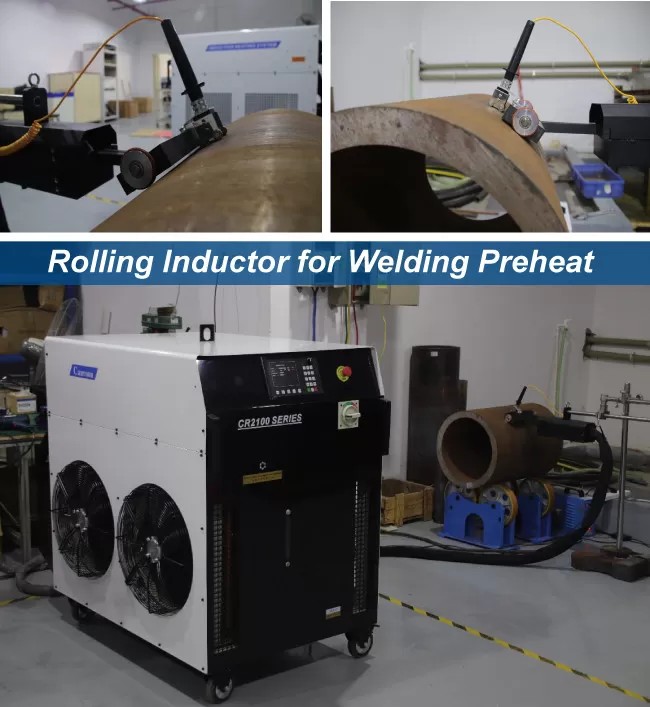
Pipe and Seam Welding
Induction welding is used to make pipes. It joins long metal strips to form pipes. The welder heats the edges of the metal strip fast. Then, you press the hot edges together. This makes a strong seam. This works for oil pipelines, water pipes, and tubes.
Many industries use induction for pipe welding. Shipbuilders use it to make big pipes for ships. Metal shops use it to make tubes for machines and buildings. You get quick production and steady welds. The process lowers defects and saves time. You can weld pipes of different shapes and sizes. Induction lets you change your manufacturing line easily.
Tip: Induction welding makes clean seams with less dirt. You do not need extra cleaning. This improves the quality of your product.
Butt Welding
Butt welding joins two metal pieces end-to-end. Induction heats the ends until they are hot enough. Then, you press them together to make a solid bond. This works for rods, bars, and plates.
Induction gives you many technical benefits for butt welding:
Fast, focused heating lowers distortion and stress.
Automated controls make the process efficient and steady.
You use fewer extra materials.
Strong bonds form with good control of the metal structure.
Car and tool makers use butt welding for parts like axles and shafts. Oil and gas companies use it to join pipes in the field. You get strong welds and less downtime. Induction makes welding safer and faster.
Pre-Heating Processes
Pre-heating gets metal ready before welding or cutting. Induction heats the metal to a set temperature. This step helps stop cracks and weak spots in the weld.
Induction gives many benefits for pre-heating:
Fast, even, and controlled heating makes welds better.
You lower the risk of cracks and reduce stress.
The process is safer and uses less energy than gas torches.
Targeted heating works well for tricky parts.
You avoid open flames and cut down CO₂ emissions.
Good temperature control stops overheating or underheating.
Heating the base metal slows cooling and stops brittle metal.
Metal shops use induction to pre-heat thick plates before welding. Shipbuilders pre-heat big sections for strong welds. Factories use it to get parts ready for assembly. You make things safer and save energy. Induction gives you more control and better results.
Note: Induction pre-heating helps you meet strict rules. You avoid expensive repairs and keep your production line working well.
Induction Brazing and Soldering
Induction brazing and soldering are good ways to join metals. You can use them in electronics, HVAC, and aerospace. An induction welder heats only the spot you need. This keeps other parts safe from harm. Your work stays neat and safer.
Brazing Process
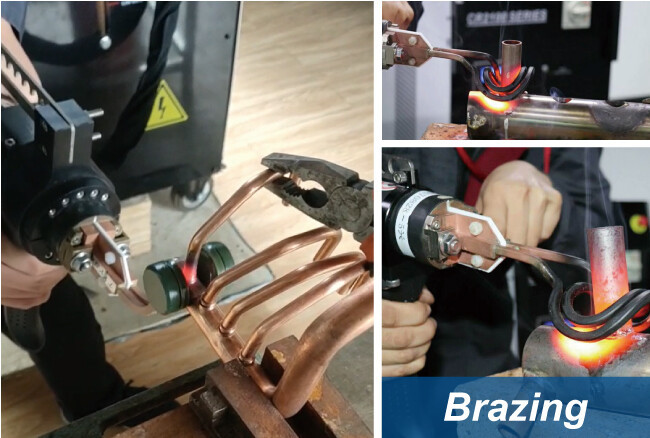
Brazing uses a filler metal to join two pieces. The base metals do not melt. Induction heats them until the filler flows and sticks. You get strong joints that do not leak. In HVAC, you can connect copper pipes fast and clean. In aerospace, you need even heating for small parts. Induction brazing gives you this control.
Here is how induction brazing helps in HVAC and aerospace:
You get the same results every time. The process is easy to automate. You can make many joints with equal quality. Induction heats only the joint, not the whole part.
Soldering Process
Soldering joins metals at lower heat than brazing. You use a filler metal that melts below 450°C. Induction heats fast and evenly. This matters in electronics, where you must protect sensitive parts. You can also use induction soldering in HVAC for small fittings.
You control the temperature better. Pre-tuned induction lowers mistakes and makes more good joints. Look at this chart to see how pre-tuned induction helps efficiency and precision:
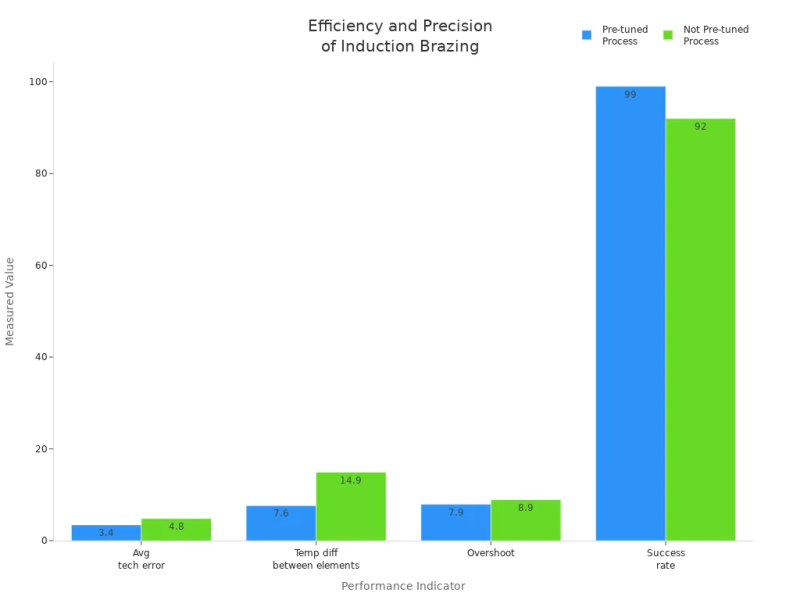
With pre-tuned induction, the mean temperature error can be as low as 2.1°C. The process yield can reach up to 97%. This means fewer errors and more reliable results.
Tip: Induction brazing and soldering help you stop overheating. This protects other processes like annealing and tempering. Your parts stay strong and safe.
Induction brazing and soldering are fast, accurate, and safe. You can use them in many industries to make strong, clean joints every time.
Induction Heat Treating
Induction heat treating changes how metal parts act. An induction welder heats metal fast and with accuracy. This makes parts stronger, tougher, or less easy to break. Many industries use induction heating to make better products. Car makers, tool makers, and oil & gas companies all use it.
Hardening
Hardening makes metal parts stronger and harder to wear out. The surface gets hot with induction, then cools quickly. This forms a hard outside but keeps the inside tough. Car makers need hard gears, camshafts, and crankshafts. Induction hardening gives you good control and even results.
Annealing
Annealing makes metal softer and takes away stress. Induction heating warms the metal, then it cools slowly. This makes metal easier to bend and less likely to crack. Factories anneal wires, tubes, and sheets often. This step stops breakage and helps with the next steps.
Tempering
Tempering comes after hardening. You heat the metal again, but not as hot. This step makes the part less brittle and keeps it tough. Tool makers use tempering to help tools last longer. Induction tempering gives you:
A hard outside that does not wear down fast.
Strong tools that do not break easily.
Tools that bend more before breaking.
Stress Relieving
Stress relieving takes away stress left from welding or shaping. Induction heating warms the part just enough to relax it. This helps stop cracks and early breaks. Big industries like oil & gas use this to make pipes and parts last longer.
Induction stress relieving lets you control the heat well. It heats parts fast and evenly. You get parts that bend more, stay tough, and last longer.
If you want good results, induction heating is fast and saves energy. Many industries use it to make better products that last longer and save money.
Induction Shrink Fitting and Melting
Shrink Fitting
Induction heating is used for shrink fitting in factories. This method helps put machine parts together with great accuracy. Induction heating works much faster than using an oven. You can turn the heat on or off right away. The heat goes only where you want it. This saves energy and keeps the metal strong.
Shrink fitting uses heat to make metal parts fit. Here is what happens:
You heat one part with induction. The metal gets bigger.
You put this hot part over another part that is cool.
When the hot part cools down, it gets smaller and holds the other part tight.
This way, the parts are joined but not forever. You can take them apart later if you need to. Induction shrink fitting lets you control the heat very well. You do not overheat the parts. This keeps your parts in good shape. Many factories use this for gears, bearings, and shafts.
Tip: Induction heating is quicker and uses less energy than old ways. You can put parts together fast and keep your work moving.
Melting
Induction melting is important in making things and recycling. Induction melting machines melt metal faster than old machines. This quick heating helps you finish work sooner. You can meet tight schedules and make more products without losing quality.
Induction melting lets you control the heat better. You keep the metal at the right temperature. This makes the metal better and stops it from losing too much to air. This way uses less energy, so you spend less money. You also get back more metal, about 3-5% more. For big recycling jobs, this means more money and less waste.
Faster melting helps you make more things.
Good heat control keeps your metal good.
Getting more metal back means you earn more.
Induction furnaces help you lose less metal when recycling. You can get up to 4% more metal back. This makes induction melting a smart pick for making and recycling metal.
Note: Induction melting saves energy, gets you more metal, and makes better products.
Advantages of Induction Welding
Efficiency and Cost Savings
You can boost your production line with induction welding. This method gives you rapid heating and steady results. You save money and time because the process uses less energy and works faster than old methods. Here are some ways induction welding helps you:
You save about 40% on energy for the same line speed.
You can prevent 80 metric tons of CO2 emissions each year.
You save up to €12,500 every year, which adds up to €450,000 or €90 per hour.
You cut your line costs by 15%.
You finish projects faster because heating is quick.
You get a consistent heat-affected zone, so your products turn out even.
Your workers stay safer since the coils stay cool during heating.
Canroon’s induction welding solutions help you reach these savings. You can use their tools for many manufacturing applications, from pipes to car parts.
Precision and Safety
Induction welding gives you high precision. The machine heats only the workpiece, so you get even temperature control. This keeps your parts from bending or warping. You can trust the welds to stay strong and last longer. The process also lowers the risk of cracks and weld failure. You keep your workers safe because only the metal gets hot. There is less chance of burns or fires compared to old welding methods.
You can count on Canroon for safe and accurate welding. Their systems help you make better products in every application.
Environmental Impact
Induction welding is better for the planet. You use less energy, so you lower your carbon footprint. You can stop using open flames and reduce air pollution. The process makes less smoke and fewer fumes. You help your company meet green goals and keep your workplace clean.
You can see why many industries choose induction welding for their manufacturing needs. You get better results, save money, and protect the environment.
You can find induction welders in many industries. They help with pipe welding, brazing, heat treating, and shrink fitting. Induction welding is quick and accurate. It is easy to use with machines and saves energy. The joints are strong and do not bend out of shape. Many factories now use more machines and digital controls. They also try new materials. If you want to use induction welding, you should follow some tips:
You can count on Canroon for good induction welding tools.
FAQ
What materials can you weld with induction welding?
You can weld steel, stainless steel, copper, and aluminum. Induction welding works on ferrous and nonferrous metals. It makes strong joints with many shapes and sizes. The results are clean and neat.
Is induction welding safe for workers?
Induction welding is safer for workers. Only the metal gets hot, so burns are rare. You do not need open flames. There is less smoke and fewer fumes in the air.
How does induction welding save energy?
Induction welding heats just the spot you need. This uses less electricity than older ways. You finish jobs faster and pay less for energy.
Can you automate induction welding?
Induction welding is easy to automate. Machines set the heat and timing for you. You get steady results and make products faster. Automation lets you do more work with less effort.
Previous:
Next:
Sign up for updates