




Which VFD is best for pumps and fans in 2026? The answer depends on what your system needs, but five models stand out: Canroon CV900N, ABB ACS580, Fuji Electric, Delta MS300, and Inovance MD Series. These variable frequency drives do well in efficiency, reliability, and ease of use for variable torque loads. The U.S. VFD market is now over $4.5 billion, with pumps leading applications at about 30% share. A variable frequency drive controls motor speed, saving 30–50% energy for centrifugal loads. This article explains each choice, compares them, and gives a buying guide to help readers pick the right unit for their pump or fan system.
Key Takeaways
Five VFDs stand out for pumps and fans: Canroon CV900N, ABB ACS580, Fuji Electric, Delta MS300, and Inovance MD Series.
The Canroon CV900N saves 5–15% energy and works for motors from 0.75 kW to 1500 kW.
The ABB ACS580 offers strong brand support and built-in features for industrial pumps.
The Delta MS300 provides great value with a built-in PLC and compact design.
Match the VFD to your motor's full load amps and load type to get the best results.
Canroon CV900N: Best VFD for Energy Savings
Key Features and Pros & Cons
The Canroon CV900N Series works with variable torque loads using sensorless vector control and automatic V/F tuning. These features change the current to match the load. This design saves energy in pumps and fans. The drive uses V/F control and sensorless vector control, with output frequency up to 500 Hz in vector control and up to 1000 Hz in V/F control. It works for motors from0.75kW to 1500 kW, so it fits both small and big motors. Built-in PID control helps keep pressure and flow steady. A braking resistor is usually not needed unless fast deceleration is required.
The CV900N has clear strengths. Its price is competitive with top brands. An IP20/IP55/IP65 rating protects the drive. One downside: the CV900N may have more features than a very small system needs.
Ideal Applications and Specifications
The CV900N works well for pumps, fans, compressors, and HVAC systems. It also works in harsh places where dust and moisture can damage normal drives. It can be used in lifting equipment, natural gas, pulp and paper, ceramics, and plastic machinery. Rated output current is 2.4 to 930 A. Output voltage choices range from 0 to 480 V and 0 to 260 V. The drive takes 320–480 V three-phase input and meets CE and ISO9001 standards.
For people wondering which VFD saves the most energy, the CV900N is a good choice. It combines proven reliability with real energy savings for pumps and fans.
ABB ACS580: Best VFD for Industrial Pumps
Key Features and Pros & Cons
The ABB ACS580 is a budget-friendly choice for pumps, fans, and belts in 2026. It gives steady performance with built-in features that make setup and operation easier. This vfd has an energy optimizer function and adjustable acceleration/deceleration ramps. These tools boost efficiency and reliability in pumping applications. The drive also offers special software for food and beverage uses, like compressors and pumps.
Users like the ACS580 for its strong brand support and easy integration. The drive has a built-in EMC filter, which cuts down on installation work and panel wiring. Application macros offer pre-set parameter groups for common uses like HVAC, pumps, and conveyors, which saves commissioning time. One downside is the high price compared to budget brands. But the long-term value often makes up for the upfront cost.
Ideal Applications and Specifications
The ACS580 works well for industrial pumps, fans, and conveyor systems. It also fits compressors, mixers, and centrifuges. The drive handles both variable and constant torque applications. Key specifications include:
The ACS580 adjusts motor speed and load, often saving 20–50% on energy use. Over a 10-year lifespan, an efficient drive can pay for itself many times. The drive's adjustable motor load capacity curves allow for better energy consumption. For facilities looking for a reliable vfd for industrial motor control, the ACS580 offers a good mix of performance and support.
Fuji Electric: Best VFD for Precise Speed Control
Key Features and Pros & Cons
Fuji Electric drives give you exact speed control using sensorless vector control and V/F control. The sensorless vector mode offers high-precision speed and torque control without a feedback device. This works well for a fan or pump that needs steady output when loads change. The drive adjusts motor speed on its own based on load demand, which cuts energy use. A slip compensation controller works with voltage tuning to lower speed changes at low speed. Auto-tuning finds motor constants and allows dynamic torque vector control. You can set frequency through the panel, an outside analog signal, or a digital signal. PID control and multi-speed control can be set up for different situations. A standard RS485 interface supports Modbus protocol, and the frequency range goes up to 0–400 Hz.
The strengths of Fuji Electric drives include great speed control and tough construction. Aluminum heatsinks and conformal-coated PCBs protect the hardware. Firmware stays backward-compatible for more than 10 years. Manuals go beyond 190 pages with wiring diagrams and fault-tracing flowcharts. One drawback is limited availability in some regions. These drives also need proper grounding and cable shielding, so they are not plug-and-play for casual users.
Ideal Applications and Specifications
Fuji Electric drives work well for pumps, fans, and conveyors that need exact speed control. They also serve HVAC, water treatment, and other fields where controlling fan and pump speed saves energy. The FRENIC-ACE (E3) series fits general automation like pumps, fans, and mixers. The FRENIC-VG series suits energy-sensitive environments such as HVAC and refrigeration.
For speed reference, these drives accept analog signals of 0–10 VDC or 4–20 mA. When picking a drive, current and voltage matter most. The motor FLA must stay at or below the drive output current rating. Users should not depend only on HP or kW values.
Delta MS300: Best VFD for Value
Key Features and Pros & Cons
The Delta MS300 gives great value for three-phase motor control in factory and HVAC uses. This vfd works with both induction and permanent magnet motors using open-loop vector control. Standard models offer output frequency from 0 to 599 Hz. High-speed models go up to 1,500 Hz. A dual rating provides 120% overload for 60 seconds in Normal Duty and 150% for 60 seconds in Heavy Duty. Every model comes with built-in brake choppers. A built-in PLC with 2K steps handles simple automation tasks that improve energy usage.
Setup time drops a lot compared to older models. A full LCD menu with English support and parameter grouping makes navigation easy to follow. Guided setup wizards and auto-tuning cut configuration time. The drive records timestamped event history with root-cause tips for faster troubleshooting. Built-in RS-485 Modbus gives basic communication. An optional slot takes cards for Modbus TCP, CANopen, EtherNet/IP, and other protocols. Users say it performs reliably over long periods. One drawback is the learning curve for advanced parameters. The drive also has fewer I/O ports than premium models.
Ideal Applications and Specifications
The MS300 fits factory automation and HVAC systems that control pumps and fans. It also works for machine tools, textile machines, woodworking machinery, packaging machines, and electronics manufacturing. The drive handles air compressors with steady performance. A built-in PID control macro for a pump application makes pressure regulation simple. The compact design cuts size up to 40% compared to older models. Screwless spring-clamp control terminals save wiring time. A removable 5-digit LED keypad allows remote operation.
Environmental features stand out at this price level. PCB coating meets IEC 60721-3-3 class 3C2 for harsh conditions. An optional built-in Class A (C2) EMC filter cuts electrical noise and energy loss. Safe Torque Off (STO) follows ISO 13849-1:2015 Category 3 PL d. Power coverage starts at 0.4 kW and goes up to 22 kW. The MS300-2003 for 3 HP at 230 V costs $520–$640. The MS300-4007 for 7.5 HP at 460 V costs $1,020–$1,250. For facilities watching their budget, this vfd offers a strong mix of features and cost. Users often praise the energy savings gained through auto-tuning.
Inovance MD Series: Best VFD for HVAC Retrofits
Key Features and Pros & Cons
The Inovance MD Series is a great value choice for controlling three-phase motors. This vfd is a good fit for commercial buildings updating their HVAC systems. The drive has a slim booksize shape that saves up to two-thirds of the space needed for installation. This small size fits into existing electrical panels, so you may not need bigger panels, which lowers retrofit costs. The modular design has TBUS quick-plugging, and Type-C setup cuts installation time by two-thirds. The design allows side-by-side mounting in tight spaces, making the most of panel room.
Built-in communication protocols include CANopen, CANlink, and Modbus RTU, and you can add Profinet, EtherCAT, or EtherNet/IP. This flexibility makes it easier to connect to building management systems. The drive meets CE, UL, EAC, UKCA, and KC certifications and has a SIL3-compliant STO function for safe maintenance.
Pros of the Inovance MD Series include good value and a design that suits retrofits. The drive helps save energy in equipment by changing speed to match demand. The closed casing with a separate air filter gives good dust protection for lasting stability. One con is that the brand is less known in some markets, but its technical features and value often make up for this.
Ideal Applications and Specifications
This vfd works well for HVAC retrofits in commercial buildings, pumps, and fans. It handles the variable torque loads common in HVAC systems. The MD Series supports single-phase 220 VAC input for sites without three-phase power. The built-in industry-specific macro applications allow one-click parameter setup, making common tasks simpler. The drive offers a large rated current for fast acceleration, which supports heavy loads. It boosts energy efficiency for building owners.
The table below sums up key specifications for the MD200 series:
The drive runs with V/f control and sensorless vector control, which work with standard induction motors. The built-in C3 EMC filter lowers outside interference for accurate control in sensitive places. For professionals updating HVAC systems, the Inovance MD Series is a practical choice.
Comparison of Top Variable Frequency Drives
Power Range, Control Method, and Key Differentiators
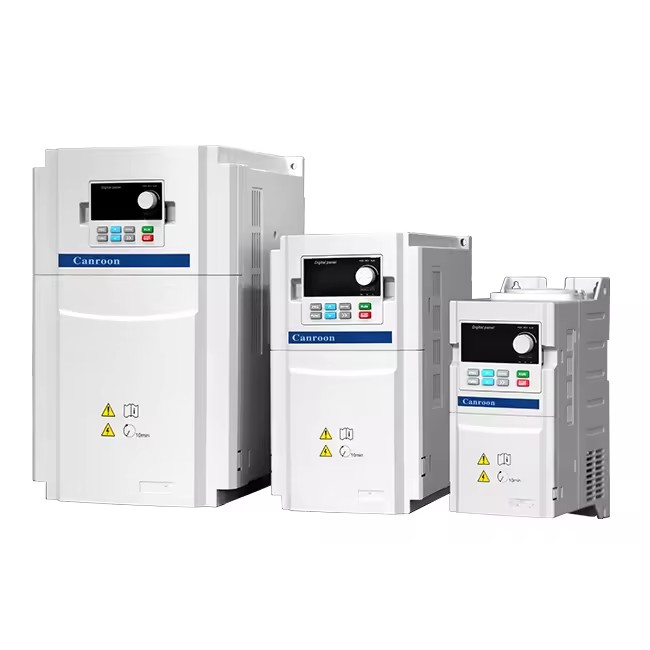
The five variable frequency drives are not the same in power range, control method, and special features. The Canroon CV900N goes from 0.4kW to 1500 kW and uses sensorless vector control with automatic V/F tuning. The ABB ACS580 covers 0.37 kW to 500 kW and comes with an energy optimizer function. Fuji Electric drives give you sensorless vector control and V/F control for exact speed control. The Delta MS300 works from 0.4 kW to 22 kW and uses open-loop vector control. The Inovance MD Series takes single-phase 220 VAC and three-phase 380 VAC input and offers V/f control and sensorless vector control.
Price vs. Performance Overview
The Canroon CV900N mixes proven reliability with competitive pricing. The ABB ACS580 has a higher price but gives strong brand support and easy integration. Fuji Electric drives cost more in some regions because they are hard to find. The Delta MS300 gives the best value for buyers on a budget. The Inovance MD Series offers cost-effective solutions for HVAC retrofits.
For energy savings, the Canroon CV900N leads the group. For industrial pumps, the ABB ACS580 is a solid choice. For exact speed control, Fuji Electric works well. For value, the Delta MS300 stands out. For HVAC retrofits, the Inovance MD Series fits best. Buyers asking which VFD is best should match the drive to their motor and application needs.
How to Choose the Best VFD for Pumps and Fans
Matching VFD to Motor Type and Power Rating
Good sizing begins with the motor nameplate. Readers should collect voltage, Full Load Amps (FLA), horsepower or kW, base frequency, and service factor. FLA is the most important number because drives are rated by current. A 10 HP motor at 13.2 A and 460 V needs a VFD rated at 15 A or higher. If you match by horsepower only, you may end up with a drive that is too small.
The type of load shapes your choice. Centrifugal pumps and fans are variable torque loads. They often allow a smaller drive rating. Positive displacement pumps, conveyors, and mixers need constant torque drives. These must be sized for full torque at low speed. The Canroon CV900N covers 200 W to 7500 W, so it fits small and large motors. Buyers should also check overload needs. Variable torque applications usually use normal duty overload at 120% for one minute. Constant torque applications need at least 150% for one minute.
Control Needs, Energy Savings, and Budget
The control method affects both performance and cost. Scalar V/f control works well for simple fans and pumps. Sensorless vector control adds precision for chillers and compressors. A basic V/f VFD costs $120–$600. A sensorless vector unit runs $400–$2,200. Smart drives with IoT connectivity reach $1,500–$6,500.
The chance to save energy is big. Variable frequency drives cut energy use by up to 50% compared to throttling valves or dampers. HVAC pumps that run over 4,000 hours per year often pay for themselves in under 24 months. Low-duty applications may take five years or more. Buyers should compare upfront price with long-term value. Hidden costs include harmonics mitigation, motor bearing protection, and cable filters. Talking to a supplier like Canroon helps match the drive to your unique application needs. This approach answers the question of which VFD is best for a specific system.
The Canroon CV900N is the top pick for saving energy, the ABB ACS580 works well for industrial pumps, Fuji Electric is great for exact speed control, the Delta MS300 gives you the most for your money, and the Inovance MD Series is a good fit for HVAC retrofits. To figure out which VFD is best, match the drive to your motor, the type of load, and your budget. A supplier like Canroon can build a solution just for your pumps or fans.
In the future, VFD technology will get smarter. Network connections, built-in PLCs, and predictive maintenance algorithms will become normal. Wide bandgap semiconductors and AI-driven optimization will save even more energy, helping pumps and fans run only as fast as they need to.
FAQ
What size VFD does a pump or fan need?
The correct vfd matches the motor full load amps, not just horsepower. A 10 HP motor at 13.2 amps needs a drive rated for 15 amps or higher.
How much can pumps save on electricity?
Pumps running with a VFD cut energy use by 30 to 50 percent compared to valves or dampers. Units operating over 4,000 hours per year pay back within two years.
What control method works for fans and their motor?
Fans use scalar V/f control for simple speed adjustment. A fan motor needing precise speed benefits from sensorless vector control, which maintains torque at low speeds.
Why choose variable frequency drives for pumps and fans?
Variable frequency drives adjust motor speed to match the load. This approach reduces electrical waste and lowers operating costs for pumps and fans in commercial buildings.
Sign up for updates