





You turn on an electric coil. This creates a strong magnetic field. The field makes quick eddy currents in metal. These currents heat your metal part fast.
Old gas furnaces waste time and power. Induction heat treatment warms small areas in seconds. You save power and speed up work. New systems give you full control.
Use this guide to learn surface hardening. You will improve power, frequency, coil shape, and quenching to make great metal parts.
Key Takeaways
Induction heat treatment uses magnetic fields. They heat metal parts very fast.
High frequencies heat the top layer. Low frequencies go deep inside.
Single-shot heating helps tricky shapes. Scanning works well for long shafts.
Special liquids control cooling speeds. Good cooling stops metal cracks.
Tempering lowers stress in metal. It makes metal hard and tough.
New electric systems save power. Digital tools control heat settings easily.
Fundamentals of Induction Heat Treatment
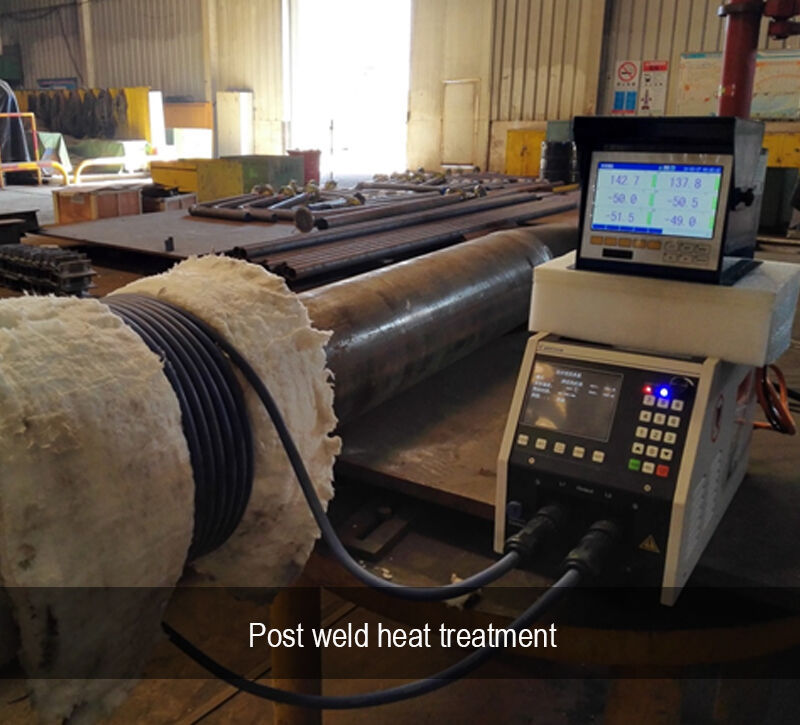
You can learn induction heat treatment. Just follow simple science rules. High-frequency electricity changes metal fast.
Electromagnetic Principles and Joule Heating
Faraday's Law and Eddy Currents
Faraday's law shows magnetic fields. They make power inside metal.
An alternating current flows through a coil. This current builds a fast magnetic field. Put your metal part in this field. The field forces swirling currents into metal. Engineers call these loops eddy currents.
Resistive Joule Heating
Eddy currents make strong heat. They fight the metal's natural resistance. This heat rises fast in small zones.
Hysteresis Loss Mechanism: High magnetic permeability values help your start. Values run between 100 and 500. The metal makes friction heat. Magnetic motion creates this heat. This happens below its critical point.
Thermal Dependencies: Metal properties set your energy needs. Weight, heat capacity, and temperature matter. They show your exact power needs.
Skin Depth and Current Distribution
Reference Depth Calculations
Alternating current moves unevenly in metal. The top current stays near the edge. Current drops fast near the core.
Pick high frequencies for surface flow. Low frequencies go deep in steel.
Electrical Resistivity Effects
Metal properties change your heat work:
Thermal Transients and Phase Shifts
Hysteresis Below Curie Point
Magnetic hysteresis helps your initial heating. Metal loses magnetism at Curie point. Heat levels must reach this mark.
Non-Magnetic State Transitions
Metal changes follow a strict timeline:
Initial Uniform Stage (0–12 seconds): Surface and core warm up together. This happens before magnetic changes.
Transient Hot Stripe Formation (16 seconds): Hot spots show up fast. Metal crosses the magnetic mark.
Amplification Phase (16–22 seconds): Hot zones grow much deeper. They spread near transition lines.
Merging Non-Magnetic Layer (26–28 seconds): Hot stripes meet together. They form a smooth top layer.
Adjust power during these changes. This protects metal from bad damage. Good induction heat treatment creates strong parts. These parts handle heavy stress well. Smart induction systems run this automatically.
Induction Heat Treating Control Parameters
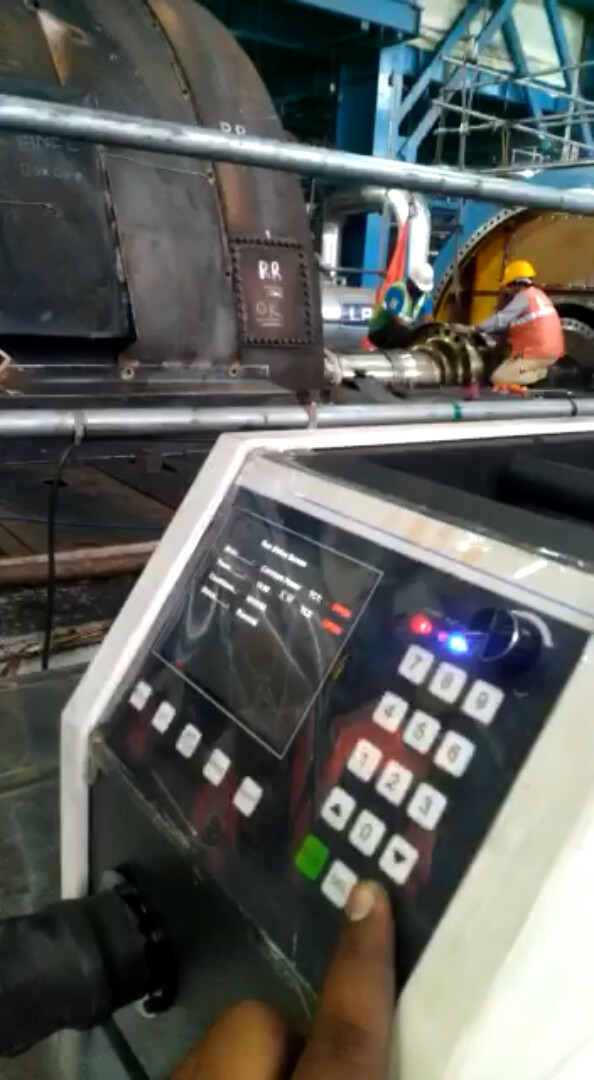
Watch machine settings to learn induction heat treatment. Small changes shift heat in metal.
Canroon power units offer great control. They change fast during heat cycles.
Sinusoidal Pulse Width Modulation (SPWM): Makes signals. Turns DC power into AC power.
Phase-Locked Loop (PLL) Synchronization: Tracks power angles. Keeps grid integration very smooth.
dq0 Reference Frame Conversion: Splits AC power. Sets active and reactive power.
Droop Control Logic: Shifts power output. Helps machines share energy loads.
Dual-Loop Feedback Control: Uses two power loops. Tracks fast load changes.
Frequency and Case Depth Matching
Power frequency choices fix hardness depth. Match frequency to part size.
High Frequency Surface Effects
High frequencies push power to edges. Use them for thin shafts. Fast heat stops depth growth.
Medium Frequency Deep Penetration
Medium frequencies push current deeper. Use them for deep, heavy axles. Deep power creates smooth layers.
Power Density and Thermal Dwell
Power density sets heat speed. Balance power to stop metal flaws.
Kilowatt Density Rules
Divide kilowatt power by part area. High density warms surfaces fast. Low density protects sharp edges.
Thermal Conduction Limits
Heat moves toward cold cores. Metal absorbs heat slowly. Use correct dwell times naturally.
Matching networks use L-matches for power transfer. They change high volts to high currents.
Inductors and Magnetic Concentrators
Coil shapes push fields to parts. Custom shapes create even heating.
Single vs Multi-Turn Coils
Single-turn coils heat narrow bands. Multi-turn coils heat broad areas. Pick single-turn coils for fast scans. Pick multi-turn coils for static jobs.
Keep air gaps tight for top work.
Flux Concentrator Selection
Concentrators push magnetic fields straight into target zones. They bring good gains:
Field Realignment: Concentrators shift magnetic vectors to fix line paths.
Process Optimization: Blocking stray fields boosts heating control.
Use moldable composites for hard shapes:
Filling Irregularities: Moldable SMC fills uneven copper spaces inside small coils.
Elimination of Field Leakage: Total fit stops field leaks completely.
New composites fix tough heat problems:
3D Field Handling: Composites control complex 3D magnetic fields easily.
Custom Flux Routing: Mixed materials guide magnetic field paths well.
Good settings keep induction heat treatment systems working fine. Proper tuning builds better parts.
Induction Hardening and Microstructural Control
Control the inner metal. This helps master surface hardening. Fast electricity alters metal structure quickly. Make strong outer skins. Keep inner metal cores safe.
Austenitization Kinetics
Rapid Phase Transformations
Fast heating alters normal phase rules. Standard heating acts slowly. Fast induction hardening adds quick heat. This pushes transition marks upward.
Faster heating raises Ac1 and Ac3 heat marks. They rise by 15°C to 30°C.
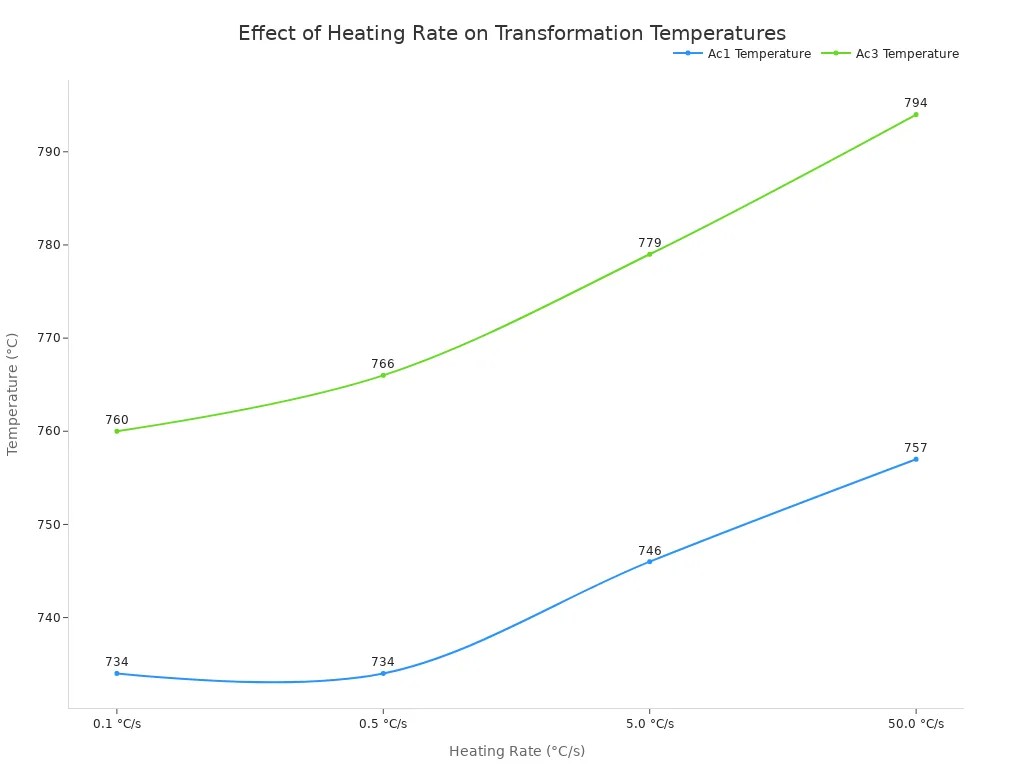
Set higher heat targets. This finishes metal phase changes. High power boosts atomic flow.
Grain Growth Suppression
High power stops grain growth during induction surface hardening. Use good initial structures. Keep heating times short:
Quenched & Tempered (Q&T) Prior Structure: Use even Q&T structures. Metal responds fast to induction heating. Grains grow very little.
Normalized Fine-Grain Ferrite-Pearlite Structure: Mix fine ferrite and pearlite evenly. This lowers required heat levels. It stops grain growth.
Avoidance of Large Carbides: Big carbides need longer heat time. This causes grain growth.
Control heating cycles strictly. Stop overheating and thermal runaway. High heat causes grain growth. Keep soak times brief. Lock in fine grains. This resists heavy loads.
Scan vs Static Heating Methods
Progressive Scanning Setup
Move long parts inside active coils. Pass parts through magnetic fields steadily. Continuous motion heats small zones sequentially. Scan long shafts easily. Save large power needs.
Single-Shot Heating Rules
Single-shot static heating warms full zones at once. Place parts in fixed coils. Apply high power fast. Hold parts still or turn them.
Pick single-shot heating for deep, complex hardness. Pick scanning setups for long, straight shafts.
Quench System Engineering
Polymer and Water Quenchants
Quenching cools hot metal fast. This creates hard martensite. Water cools metal fast. Sharp cooling cracks alloy parts. Polymer fluids adjust cooling rates. Polymer leaves films to slow initial heat loss.
Hotter polymer fluids cool metal slower. Track fluid temperatures closely. Avoid soft spots on parts. Good fluid control completes hardening and tempering setups.
Spray Ring Dynamics
Spray rings shoot high-velocity liquid on hot metal. Mount quench rings behind scanning coils.
Angle spray nozzles to stop coil splash-back.
Hold steady liquid pressure to break vapor fast.
Use even hole patterns to stop soft spots.
Good spray ring setups guarantee hard surface layers.
Post-Treatment Tempering and Annealing
Finish your hardening and tempering steps now. Balance strength and flex inside parts.
Subcritical Induction Tempering
Rapid Tempering Cycles
Speed up your line with this process. Set higher heat goals to soften martensite fast.
Toughness Recovery Mechanisms
Fast tempering releases trapped steel strain. Warm metal below its critical mark. Fast energy boosts toughness without losing surface hardness.
Annealing and Normalizing
Homogenizing Forged Microstructures
Heavy forging causes uneven metal spaces. Use induction heat treatment to fix defects. Quick coil passes spread energy through raw parts.
Grain Refinement Processes
This heat cycle breaks large grains. Warm steel past its top mark. Fast coil passes create small, even grains.
Stress Relieving Procedures
Residual Stress Mitigation
Welding leaves deep tension in joints. Apply induction heat treatment to remove forces.
Localized Thermal Relief
Follow these steps to ease weld stress:
Pre-heating Application: Warm base areas before joining. This lowers heat gaps around welds. It stops early stress buildup.
Targeted Induction Heating: Apply heat only to weld zones. Adjust heat without warming nearby spots.
Annealing & Controlled Cooling: Hold heat to clear inner stress. Slow cooling stops thermal shock and strain.
Heat Treating Nonferrous Alloys
Metals without iron handle heat differently. You must change machine settings for them.
Aluminum and Copper Processing
Managing High Thermal Conductivity
Aluminum and copper push heat away fast. These metals carry heat very quickly. Normal furnaces waste power on them. High frequency currents put power on surfaces. You make heat inside target areas. Fast heat stops loss into cores.
Solution Treatment Parameters
Nonferrous metals need exact temperature controls. Mixed elements must melt into metal. Fast heat speeds this step up. It stops low-temperature borders from melting. You finish this work very fast. Fast water quenching locks elements inside.
Tip: Copper needs more current for heat.
Titanium and Superalloys
Inert Shielding Requirements
Hot titanium takes gas from air. Oxygen makes titanium edges very brittle. You must cover coils with argon. Closed induction setups shield metal from oxygen. Clean gas keeps surfaces very safe.
Thermal Uniformity Controls
Nickel superalloys need exact heat levels. These metals move heat quite slowly. Balance power density to stop hot spots. Multi-zone coils spread heat very evenly. Smart pyrometers track heat in real time. This careful control makes reliable parts.
Defect Prevention and Quality Control
Good control stops costly metal flaws. Adjust key settings to fix hardening problems.
Mitigating Distortion and Cracking
Thermal Gradient Control
Big heat shifts warp metal parts. Balance power to stop quick heat shock. Lower corner heat to reduce stress. Use smooth coils to spread energy.
Quench Vapor Phase Control
Unstable vapor causes uneven cooling. Adjust process steps to fix cooling defects:
To Eliminate Soft Spots and Low Hardness:
Lower the polymer quenchant mix ratio.
Speed up flow and clean spray holes.
Cool down your overall quenchant fluid.
To Reduce Part Distortion:
Add more polymer for slower cooling.
Warm up your quenchant fluid.
Lower spray pressure and fluid flow.
Wait longer before you quench metal.
NDT and Metallurgical Testing
Case Depth Verification
Safe testing checks hard top layers fast. Eddy current tools measure depth safely. Ultrasonic devices inspect inner boundaries deep inside.
Crack Inspection Protocols
Dye tests show small top cracks fast. Check gear teeth after quick cooling. Quick checks stop bad parts moving ahead.
Automated Process Monitoring
Closed-Loop Pyrometry
Canroon digital systems control heat settings automatically. Built-in sensors read surface heat constantly. These smart systems tweak power fast. Data logs save heat history for safety.
Energy Monitoring Systems
Digital units track power for every part. Watch power use to spot coil wear. Stable setups give accurate heat doses. Smart systems stop power when levels drift.
You learn induction heat treatment by using correct tools. You set frequency, power, coil shape, and quenching. Modern electric systems like Canroon work with high control. They make every metal part very strong and even.
Check your old tools today. Upgrade them to save power!
FAQ
What is induction heat treatment?
Quick Definition: Direct electromagnetic heating for metals.
You use magnetic fields. They warm metal parts fast. Electric currents flow inside. They make exact heat. This process saves power. It speeds up your work.
How does induction heat treating improve part quality?
You heat single areas. You skip the whole part. This control stops warping. It prevents inside damage. Modern heat treating creates strong parts. Results stay the same every time.
Why should you choose induction hardening over furnace methods?
Furnace systems take hours. They waste power. Induction hardening builds surface strength in seconds. You save energy. You cut carbon waste. Your room stays cooler.
What role does tempering play after hardening?
Hard steel breaks easily under heavy loads. You perform tempering. It releases internal stress. It brings back metal toughness. This step balances surface hardness. It improves inner strength.
Can you process nonferrous metals with induction systems?
Yes! You can heat aluminum. You heat copper and titanium. These metals need higher frequencies. They need custom power settings. You keep top strength. You stop surface damage.
How do you pick the right frequency for your part?
Check your target case depth. High frequencies warm outer shaft edges. Lower frequencies go deeper. They reach heavy steel cores. You match frequency to your goals.
Sign up for updates