




The induction heating market shows strong growth across the world. Many industries use induction heating because it offers fast and efficient solutions.
In 2026, experts expect the global market size to reach USD 2.4 billion.
By 2025, the market may reach USD 2.3 billion.
Projections for 2035 suggest a value of USD 4.1 billion.
The expected growth rate stands at 6.2% each year.
Key Takeaways
The induction heating market will grow a lot. It may reach USD 2.4 billion by 2026. This is because people want energy-efficient heating solutions. Industries like automotive, aerospace, and electronics use induction heating the most. They like it because it is fast, accurate, and good for the environment. New technologies like IoT and AI are making induction heating systems better. These systems are now more efficient and easier to watch and control. Energy efficiency is very important. Some systems can be up to 99% efficient. This helps companies save money and cut down on emissions. Automation is changing factories. It lets workers control and check heating in real time. This makes production better and stops machines from breaking down as much.
Induction Heating Market Overview
Market Size and Growth
The induction heating market keeps growing as industries want better heating methods. In 2024, the global market for induction heating systems was worth USD 616.5 million. Experts think it will grow to USD 879.5 million by 2030. The yearly growth rate is 7.4%. This rise is because more industries like metal processing, automotive, and electronics need these systems. The market includes both fixed and portable systems. Fixed systems make up 60% and are used in factories. Portable systems are 40% and help with repairs and maintenance outside.
The induction heating market is growing fast in Asia-Pacific, North America, and Europe. Asia-Pacific has the biggest share at 40%. North America has 25%, and Europe has 20%. The Middle East and Africa add 7-10%.
Key Statistics and Forecasts
Induction heating systems are used in many areas. Metal processing uses 45% of these systems. Automotive uses 35%. Electronics use 15%. The heat treating part was worth USD 157.6 million in 2024 and might grow to USD 242.8 million by 2030. The metal industry part grew from USD 171.8 million in 2024 to USD 256.2 million in 2030. The automotive induction heating market could be over USD 1 billion by 2035. Power generation systems will grow 6% each year from 2026 to 2035.
Canroon Electrical Appliances is a big player in the induction heating market. The company focuses on saving energy and making custom products. Canroon competes by using new technology and working closely with customers. The market is split among many companies, with new ideas and prices driving competition.
Key Trends in Induction Heating

Technology Advancements
The induction heating system market has changed a lot lately. Companies use new heating technology to make systems work better. Many new systems are smaller but stronger. These systems can be used in many ways. Manufacturers now use IoT-based monitoring to get real-time data. AI helps control temperature so heating is more exact. Predictive maintenance tools help stop machines from breaking down.
Systems work better and are more efficient.
Smaller, stronger systems can be used in many places.
IoT-based monitoring collects data right away.
AI helps keep the temperature just right.
Predictive maintenance stops machines from breaking.
Power electronics are better, so systems use less energy.
Control systems help manage temperature very well.
Modular designs make it easy to add new parts.
Over 60 new product models now use high-frequency operation. This shows the field is growing fast. More than 45% of new units in 2024 have IoT features. These new technologies help companies serve many industries. The induction heating system market keeps growing as these trends continue.
Energy Efficiency Focus
Saving energy is very important for many industries now. The induction heating system market grows because new designs save energy and cut waste. Some systems can reach up to 98.5% efficiency in some uses. Wide-bandgap semiconductors, like silicon carbide, let systems switch faster. These devices help systems reach up to 99% efficiency.
Induction heating systems use less energy than old methods. They heat only the area that needs it, so less energy is lost. This saves money and helps the environment. Induction heating systems often reach 90% efficiency. Old furnaces only reach 40–60%. These trends help the induction heating system market grow.
More industries want to use less energy, which helps the Induction Heating System Market grow. Induction heating systems use less energy by heating only what is needed. This saves energy and money. It also helps the environment by lowering carbon emissions and waste.
Automation Integration
Automation is very important in the induction heating system market. Many factories use smart systems with digital screens. These systems let workers watch and control heating in real time. Automation and AI help make heating better. Digital tools let companies check machines from far away and fix problems before they happen. This means less downtime and smoother production.
Automation helps factories keep making products and improves quality. These trends help the induction heating system market reach new industries.
Regional Developments
The induction heating system market is different in each region. Europe leads because of strong rules and a focus on saving energy. The EU Green Deal helps push new ideas and smart factories. Germany and France are top countries in Europe. Asia-Pacific is growing fast because of more factories and a need for energy-saving solutions. China and India are leaders here. The Middle East and Africa are new markets. These areas want to save energy and use better practices. South Africa and the UAE are growing quickly.
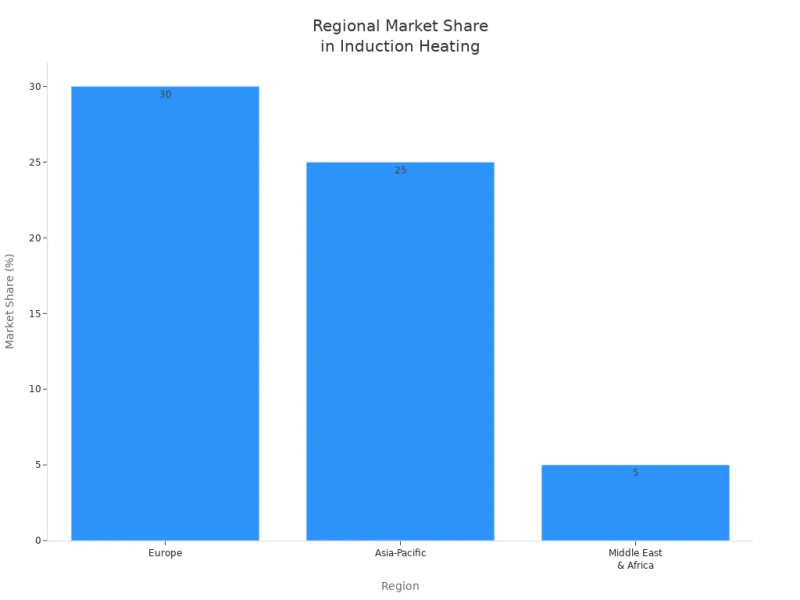
These trends show how the induction heating market changes to fit local and global needs. Growth in each region helps the whole induction heating system market get bigger.
Growth Drivers in the Induction Heating Market
Industrial Demand
Industries want better ways to heat things. Induction heating is fast and saves energy. Many companies use it because it is accurate and helps the environment. The main reasons are saving energy and making products better. Car, electronics, and metalworking companies use these systems to use less energy and follow rules.
Industries that use induction heating systems are:
The automotive sector could be worth over USD 1 billion by 2035.
The aerospace industry might reach USD 379.8 million in 2025.
Power generation will grow 6% from 2026 to 2035.
Shipbuilding could be worth USD 178.8 million in 2025.
Metal industry
Industrial manufacturing
Plastics processing
Electronics and semiconductors
Consumer appliances
Medical industry
These industries pick induction heating for its accuracy and reliability. It also helps them follow environmental laws. The market grows because factories need better ways to make things and want more automation. Canroon is important because it gives custom solutions and helps factories get modern heating.
Clean Energy and Sustainability
Clean energy and sustainability are important for the future. Many companies buy low-emission heating systems to meet new rules. East Asia and Western Europe lead this change. Their governments help companies use green manufacturing. These places spend money on new heating technology and want more innovation.
The market grows as more companies use energy-saving technology. Companies want to cut emissions and save energy. Smart factories and digital tools make induction heating even better. Canroon helps by giving solutions that support clean energy and help the environment.
Note: More companies want energy-saving technology because of new rules. This helps the environment and helps businesses grow.
Automation and Manufacturing Expansion
Automation is a big reason the market is growing. Factories use digital tools to work faster and better. Induction heating fits well in automated lines. It heats things quickly and keeps quality high.
Benefits of automation in induction heating:
Makes factories work faster and better.
Works with Industry 4.0 and smart factories.
Keeps product quality high.
Makes production smoother.
The market gets bigger as more factories use automation. Automation makes companies want better heating technology. Canroon helps by adding smart controls and helping factories get modern.
Sector Adoption (Automotive, Aerospace, Renewables)
More industries are using induction heating. In 2023, cars made up 40% of the money from induction heating. The aerospace industry in the US used 18% more induction heating systems that year. Power generation and renewables are also growing fast. Power generation will grow 6% each year from 2026 to 2035.
Industries using induction heating quickly are:
Automotive
Electronics
Aerospace
Manufacturing
Renewables
Electric cars make more companies use induction heating. Aerospace companies use it for safety and accuracy. Renewable energy projects need heating that is efficient and clean. Canroon helps these industries with new products and cares about the environment.
The market grows as more industries use induction heating. The main reasons are modernization, automation, and the need for cleaner heating. New technology and more industries using it will shape the future of the induction heating market.
Induction Heating System Market Segmentation
By Application
The induction heating system market is used in many ways. Companies use induction heating for food safety jobs like sterilization and pasteurization. Car, off-road, and ship industries use these systems to make and put together parts. In aerospace, teams use induction heating for bonding, curing, and de-icing. HVAC, electronics, and semiconductor companies need these systems for soldering, annealing, and heat exchangers. Plastics and petrochemical companies use induction heating for welding and sealing. Farms use heating systems to make equipment and dry crops. Environmental, medicine, and defense groups use them for waste and sterilization. Pyrolysis helps with waste and chemical work.
Note: Induction heating is used in many fields, so the market is flexible and can change to fit different needs.
By Industry
Many industries use induction heating systems and the market is growing. The automotive industry is the biggest user. Aerospace and electronics are also important. Manufacturing needs more systems each year. Food processing is growing slowly. The table below shows how important each industry is:
By Power Rating
Power rating splits the market into four groups. Systems under 10 kW are growing fast because they are good for small jobs and electronics. The 10 kW - 50 kW group is getting bigger in factories and for careful work. The 50 kW - 100 kW group is growing at a medium pace and is used in bigger factories. Systems over 100 kW are needed for big jobs and heat-treating.
Below 10 kW: Fast growth for small jobs and electronics.
10 kW - 50 kW: Steady growth in factories and careful work.
50 kW - 100 kW: Medium growth for bigger factories.
Above 100 kW: Needed for big heat-treating jobs.
By Region
Asia-Pacific is where the market is growing the fastest. North America has strong car and airplane industries, with a market size of USD 0.9 Billion in 2024. Rules and new technology help the market grow. Asia-Pacific reached USD 1.0 Billion in 2024 because cities are getting bigger and governments help. China, India, and Japan make up more than 75% of the demand in this area. These facts show that different places have different needs in the induction heating market.
Tip: Companies watch trends in each region to find new chances and help the induction heating system market grow.
Challenges in the Induction Heating Market
High Initial Costs
Many companies find induction heating systems expensive at first. This makes it hard for small and medium businesses to buy them. There are several reasons why the cost is high. Companies must pay a lot at the start, especially for big or advanced systems. Workers need special training, which costs more money. Upgrading electrical systems and adding safety tools also adds to the price. Some industries do not make products for long, so they do not get their money back quickly. There are not many ways to get loans or rent these systems, so companies wait until they see clear benefits.
Companies spend a lot at the beginning for new systems.
Training workers costs extra money.
Upgrading power and safety adds to the price.
Short production times mean slow payback.
Few loan or rental options make companies wait.
Technical Barriers
Technical problems also make it hard to use induction heating. Companies need workers who know how to run and fix these machines. Setting up the system can be tricky. Not every company has the right experts. High starting costs and the need for skilled workers make it tough for some businesses to use these systems.
Competition from Alternatives
Induction heating has to compete with other ways to heat things. Flash Joule heating is fast but has trouble keeping the temperature steady and working for big jobs. Gas furnaces cost less at first but waste more energy and make more pollution. The table below shows how induction heating compares to gas furnaces.
Induction heating works well for many jobs. But it does not work as well with some shapes and materials. Companies must think about the good and bad points before picking the best way to heat things.
Global Induction Heating System Market: Regional Insights
North America
North America is important in the induction heating system market. Many U.S. companies use these systems in cars, planes, and factories. They want to save energy and money. These systems also help the environment. The U.S. has about 72% of the North American market in 2025. North America makes up about 25% of the world’s induction heating system market. In 2025, the market size is USD 2,538.9 million. By 2035, it grows to USD 4,500 million. The yearly growth rate is 5.9%.
North American companies pick induction heating system market solutions because they are reliable and save energy.
Europe
Europe is a leader in using induction heating system market technology. Germany, France, and Italy use these systems in cars and big machines. People care about the environment and saving money. This makes more companies want these systems. New rules and green goals make industries use induction heating. Automation and smart factories make these systems even better. They help make products better and keep factories running well.
Europe has almost 30% of the world’s induction heating system market from 2026 to 2035.
Germany, France, and Italy use these systems the most.
Environmental rules and saving money matter a lot.
Automation and smart factories help companies work better.
Asia-Pacific
Asia-Pacific is growing fast in the induction heating system market. China, India, and Japan are the main countries using these systems. Factories want new ways to save energy and use smart manufacturing. In 2025, the market size is USD 894.1 million. In 2026, it grows to USD 949.5 million. By 2035, it reaches USD 1.66 billion. The yearly growth rate is 6.4%.
Factories in Asia-Pacific use induction heating system market solutions to follow new rules and make more products.
Taiwan Market Growth
Taiwan’s induction heating system market is getting bigger. Companies in Taiwan use new technology and want to save energy. They try to lower pollution and use smart manufacturing. Many add IoT and AI to their systems. Car and electronics companies are growing fast. Taiwan’s market grows because of new ideas and wanting to help the planet.
New technology helps the market grow.
Saving energy and helping the planet are important.
Automation and smart manufacturing use IoT and AI.
Car and electronics companies are getting bigger.
Future Outlook for Induction Heating
Market Evolution
The induction heating system market will change a lot soon. Many industries want to heat things faster and cleaner. Experts think the market will keep growing as factories get new equipment. New technology will make systems smarter and better. Companies will use sensors and data to control heating. There will be more portable and flexible systems. These changes will help factories work faster and save energy. More industries will start using these solutions, so the market will get bigger.
Opportunities for Stakeholders
Many groups will find new chances in the induction heating system market. Manufacturers can make systems that save energy and work in more places. Investors will see the market grow as more people want these systems. Engineers will build smarter machines that use data and automation. Factory owners will save money and make better products. Governments will help clean energy projects and support companies. Students and workers will learn new skills to use these systems. The market will have more jobs and new ideas for everyone.
Tip: Stakeholders should look for new trends and invest in smart technology to stay ahead.
Canroon’s Vision for 2026
Canroon wants to be a leader in the induction heating system market by 2026. The company will focus on new ideas and saving energy. Canroon will make systems with smart controls and real-time data. They want to help factories lower emissions and work better. Canroon will team up with others to make custom solutions for different industries. The company wants to help customers reach their goals and support growth. Canroon believes new technology and teamwork will help the market move forward.
The induction heating market will get bigger as more industries want faster and cleaner ways to heat things. Some important trends are new technology, saving energy, and using more automation. Many places in the world need these systems. Canroon is a top company because it makes smart products and helps customers in special ways.
There will be lots of chances for companies, workers, and people who invest money. Learning about new trends will help everyone do well in this market.
When the market grows, there will be more jobs and new ideas.
Clean energy and smart factories will be important for the future.
FAQ
What is induction heating?
Induction heating warms up metal using electromagnetic fields. The metal does not have to touch anything to get hot. Many factories like this way because it is quick and clean.
Why do industries prefer induction heating?
Industries pick induction heating because it saves energy and is easy to control. It heats only the part that needs it. This means less waste and better products.
Which industries use induction heating the most?
The automotive, aerospace, and electronics industries use induction heating a lot. Factories in these areas need heating that is fast, safe, and clean.
How does induction heating help the environment?
Induction heating uses less energy than old ways. It makes less pollution and waste. Many companies use it to follow environmental rules.
What are the main challenges with induction heating systems?
Induction heating systems cost a lot at first. Companies also need workers who know how to use them. Some businesses have trouble with new technology.
Previous:
Next:
Sign up for updates