




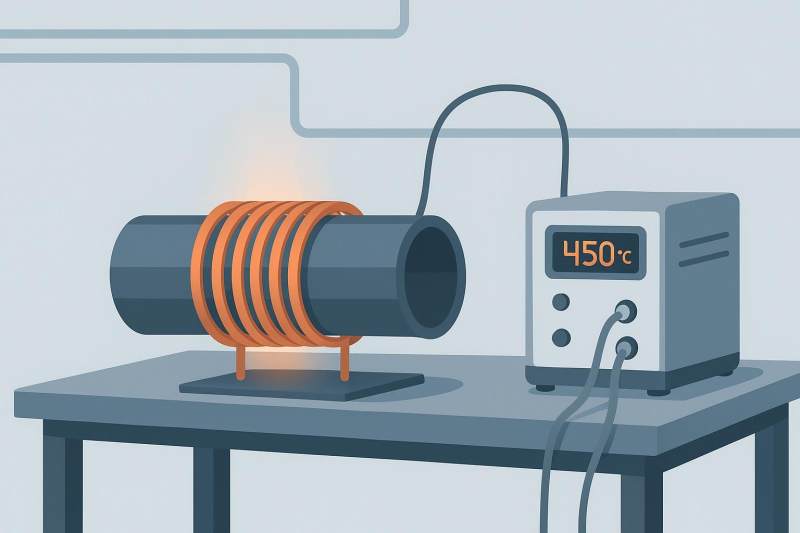
If you need cleaner, more consistent heat without an open flame, induction heating is a practical way to get there. Think of it this way: an induction coil acts like a “wireless hot plate” for metal—energy goes straight into the part, not into the air around it. This guide covers induction heating basics in plain English and gives you starter workflows for three common jobs: induction brazing basics, induction preheating steel pipe, and induction shrink fitting. You’ll also see where temperature measurement, safety, and documentation fit in for 2026 shop and field work.
Induction Heating Basics: How It Works
An alternating current in a copper coil creates a changing magnetic field. When a conductive workpiece sits inside that field, circulating eddy currents form in the metal and heat it up. In steels, there’s an extra boost from hysteresis until the Curie point, after which eddy currents dominate. Higher frequency concentrates heating near the surface (skin effect); lower frequency penetrates deeper. For a friendly primer with diagrams, see the clear explanation in CEIA’s overview, What is Induction Heating, which outlines eddy currents and hysteresis in accessible terms: CEIA – What is Induction Heating.
For deeper selection notes on heating depth and frequency trade‑offs, Fluxtrol’s 2025 primer summarizes how frequency, material, and geometry affect penetration and coil design: Fluxtrol – Basics of Induction Technique (Part 1, 2025).
Core Components and Control
An industrial induction setup typically includes a power unit/inverter, a work head and matching network, a water‑cooled copper coil, and a cooling system. Controls govern output power and time and, in many systems, enable closed‑loop temperature via thermocouples or IR sensors. Thermocouples are rugged and well suited for control and logging if you manage electrical noise with proper grounding and shielding. Infrared pyrometers read surface temperature quickly as long as you manage emissivity and maintain line‑of‑sight. Ramp/soak programs help avoid thermal shock and keep within WPS or procedure limits.
If you want a practical walk‑through of machine operation and setup, this product‑agnostic primer is a good next read: Beginner’s Guide to Using Induction Heater Machines.
Quick Frequency Guide
Use this as a rough orientation only. Always confirm with your equipment provider, WPS/PQR, and the part’s metallurgy.
Induction Brazing Basics
Brazing joins metals with a filler that melts below the base metal and flows via capillary action. With induction, heat is localized on the joint and repeatable, so you can hit the working temperature quickly without overheating nearby features. Start by cleaning and fitting the joint with an appropriate gap—many silver‑bearing alloys like a tight fit around roughly 0.001–0.005 inch; check the filler maker’s guidance.
Filler temperature windows vary by alloy. For example, Lucas Milhaupt’s page for SILVALOY 560 lists a solidus of 618 °C and a liquidus of 652 °C, with an upper process recommendation around 760 °C. Those numbers are typical for silver‑based fillers on copper/brass; always verify the exact alloy you use: Lucas Milhaupt – SILVALOY 560.
Flux is common for open‑air brazing; inert gas or controlled atmospheres can reduce flux residue and oxidation for stainless or sensitive assemblies. Heat with the coil positioned to draw filler through the joint by capillary action—warm the thicker part slightly more to balance flow, observe wetting and fillet formation, then hold briefly. Post‑braze, remove flux residue per the filler/flux manufacturer’s instructions. For practical tooling nuances (fixtures, coil styles, flux application aids), see Canroon’s overview: Induction brazing tools and their role in manufacturing.
Induction Preheating Steel Pipe
Why preheat? Weld procedures and some field installations specify a minimum temperature to reduce thermal gradients, lower hardness in the heat‑affected zone, and control hydrogen‑related cracking risk. Beginners’ primers often cite typical carbon steel preheat targets in the ~300–400 °F range, with specifics set by WPS/PQR, thickness, and ambient conditions. A concise overview can be found in Red‑D‑Arc’s explainer on when preheating is necessary: Red‑D‑Arc – Preheating welding: when and why.
Pipeline anti‑corrosion sleeves are different: adhesive activation focuses on the steel surface and coating adhesion, not welding metallurgy. Manufacturer instructions can range widely—from roughly 65–75 °C minimums for certain sleeves to around 175 °C for others, depending on coating and adhesive chemistry. For example, Berry Global’s Canusa‑CPS installation guide for GTS‑PP specifies a higher installation temperature and gives guidance on heating width for induction: Canusa‑CPS – GTS‑PP installation guide.
Field tips for beginners:
Use wrap‑around coils or flexible induction blankets sized to the joint width.
Place at least two thermocouples 180° apart to watch circumferential uniformity; add a third near wind exposure if outdoors.
Control ramp rate to avoid overshoot; log temperatures for traceability.
Disclosure: Canroon is our product. Example workflow, preheat band control: After verifying the WPS and site safety plan, a technician sets a target band (for example, 300–350 °C for a heavy‑wall carbon steel joint) on a closed‑loop induction unit with thermocouple feedback. On a system such as the Canroon CR2100, you can program a ramp to the setpoint, hold for a short soak, and log alarms if sensors drift. The coil is wrapped evenly around the pipe; thermocouples are placed at 90° and 270°. If you’re evaluating equipment classes and coil formats for field work, this short explainer provides a helpful comparison: Choosing welding preheat equipment for your project (2025).
Induction Shrink Fitting
Shrink fitting uses uniform heat to expand one component so it slides over a mating part with an interference fit. A common example is mounting a bearing on a shaft. Many bearing guides recommend heating to roughly 230–250 °F (110–120 °C) to get expansion without risking changes to steel hardness; sealed or grease‑filled bearings often have lower limits set by the manufacturer. The IBT bearing heater guide explains this window and why automatic demagnetization and delta‑T control improve quality: IBT – How bearing induction heaters work.
Handling and process hygiene matter: keep parts clean, heat evenly, work swiftly to position the component before it cools, and don’t quench unless the procedure specifically allows it. Use gloves rated for the temperatures you’ll encounter and keep a clear, stable work surface.
Canroon micro‑example, auto shutoff for a bearing inner race: A shop operator presets a 120 °C target with a short soak and two sensors—one on the inner race, one on the outer ring—to keep temperature difference in check. The heater ramps at a moderate rate and stops on reaching the setpoint, ensuring the inner race expands uniformly. The bearing is transferred to the shaft with a smooth, straight motion and allowed to cool naturally in place. For more handling reminders and setup tips, see: Essential tips for beginners using shrink fitting equipment.
Safety and Compliance
Industrial induction involves high current, strong magnetic fields near conductive materials, and hot workpieces. Treat the following as minimum guardrails and always follow your site program, WPS/PQR, and applicable code.
Electrical and servicing safety: OSHA’s Lockout/Tagout standard 29 CFR 1910.147 details how to control hazardous energy during servicing and maintenance; ensure a verified zero‑energy state before work: OSHA – 29 CFR 1910.147 Lockout/Tagout.
Thermal hazards and heat stress: Provide water, rest, and cool areas in hot environments; rotate tasks and build acclimatization into the plan. Monitor ambient heat index and the work surface temperature, especially in confined or poorly ventilated areas.
PPE and work area: Use heat‑resistant gloves and eye/face protection; manage cable routing and coil clearances; keep flammables clear even though there’s no open flame.
Troubleshooting Fast
When results aren’t what you expected, start simple. Are you measuring the right spot with the right sensor, is the coil correctly positioned, and is the frequency/power appropriate for the part size? A few quick checks often restore stability:
If heat is uneven around a pipe, rotate or widen the coil, add a second wrap, and verify thermocouple contact.
If brazing filler won’t wet, improve joint cleanliness, narrow the gap slightly per alloy guidance, and reduce time at temperature to avoid burning flux.
If shrink‑fit stalls, re‑confirm the target temperature, ensure even heating across the component, and check for burrs or misalignment.
Quick Self‑Check
In one sentence, explain how eddy currents create heat in a workpiece.
Which would you choose for a 75 mm shaft: 10 kHz or 300 kHz, and why?
Name two ways to measure temperature during induction and one pitfall for each.
For a silver‑based brazing alloy with a liquidus of 652 °C, what’s a sensible target window to start trials, and where do you verify it?
What’s one reason pipeline sleeves may specify very different temperatures than weld preheat?
Where to Go Next
If you want more product‑agnostic how‑to content, start with the machine‑usage guide, the brazing tooling overview, and the shrink‑fit tips linked above. When you’re ready to explore systems that support closed‑loop temperature control and logging for similar workflows, see Canroon’s products and datasheets collection for technical details.
Sign up for updates